Central banks & regulation
Fed Minutes Show 10-2 Vote to Hold Rate at 3.75%-4%
SummaryFederal Reserve October 2026 FOMC minutes show a 10-2 vote to keep the federal funds rate at 3.75%-4%, with almost all officials seeing more hikes ahead.
Minutes from the Federal Reserve’s October 27–28, 2026 Federal Open Market Committee (FOMC) meeting, released on November 18, 2026, showed that policymakers voted 10–2 to maintain the target range for the federal funds rate at 3-3/4 to 4 percent while signaling that additional rate increases would likely be appropriate. Two voting members dissented at the October gathering in favor of an immediate 25-basis-point increase. According to the official record published by the Board of Governors of the Federal Reserve System, almost all participants judged that further action to raise the policy rate—broadly consistent with the September Summary of Economic Projections—would likely be needed under their baseline outlooks to return inflation to the 2 percent objective in a timely manner.
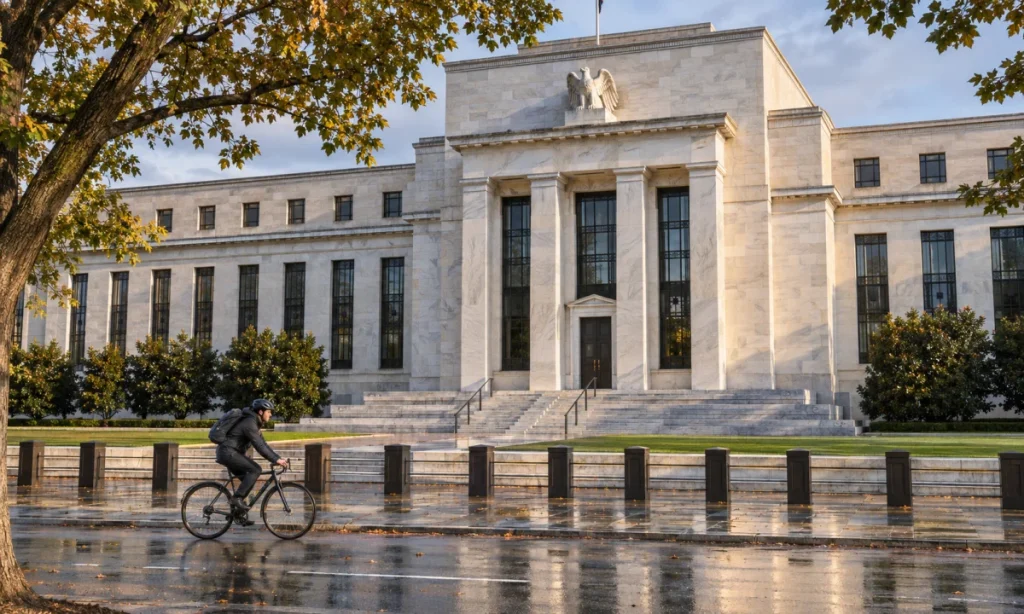
FOMC Policy Deliberations and the Dissenting View
During the October deliberations, most participants supported holding the federal funds target range unchanged to accumulate additional information on the economy. Policymakers backing the hold cited the need to evaluate the durability of artificial intelligence (AI)-related investment demand, evolving financing conditions, geopolitical developments, and the transmission of the September rate increase. A couple of participants noted that a gradual approach to policy firming would give households and businesses time to adjust to higher borrowing costs, while several observed that market-implied expectations for tightening in December and into 2027 aligned broadly with their own policy assessments.
However, a few participants who supported keeping the rate at 3-3/4 to 4 percent viewed the decision as a close call, and many emphasized the importance of communicating that the pause did not reflect a weaker commitment to the 2 percent inflation target. The Committee sought to reinforce that resolve by stating in its postmeeting release that it “will deliver price stability.” Meanwhile, the participants who favored a 25-basis-point hike at the October meeting judged that the existing policy stance was not sufficiently restrictive and saw few signs of inflation abating. A few warned that delaying action risked allowing elevated inflation to become entrenched or forcing a larger and more disruptive tightening later. Looking ahead, a couple of participants noted that an increase larger than 25 basis points could warrant consideration at the next meeting if incoming inflation data proved unfavorable.
Inflation Drivers, AI Investment, and Staff Economic Estimates
The policy debate took place against a backdrop of solid economic growth and persistent price pressures. Based on consumer and producer price index data available at the time of the meeting, Federal Reserve staff estimated that 12-month total personal consumption expenditures (PCE) inflation rose to 3.6 percent in September, driven by a rapid increase in consumer energy prices. Core PCE inflation, excluding food and energy, was estimated to have edged up to 3.1 percent in September. Both measures stood above their year-earlier levels, which staff attributed largely to earlier tariff increases, energy inflation, and upward pressure on consumer goods prices tied to the AI buildout. In the labor market, the September unemployment rate edged up to 4.2 percent, remaining 0.2 percentage point below its average in the second half of 2025.
AI Buildout and Upside Inflation Risks
While most FOMC participants expected inflation to decline over time toward 2 percent as tariff effects waned, energy contributions eased, and AI-related pressures moderated, the vast majority saw upside risks to the inflation outlook. Policymakers pointed to higher energy prices, ongoing refined fuel supply constraints, and the macroeconomic effects of AI infrastructure spending:
- Many participants viewed the AI buildout as a material source of inflation risk, with some judging that the investment surge could push aggregate demand above supply if capacity expanded more slowly than expected.
- A majority noted the risk that higher input costs could be passed through more broadly and persistently to business and consumer prices.
- A few countered that price pressures could abate as productive capacity and productivity rose, while several remarked that heightened scrutiny of AI sector returns and financing could slow capital spending and ease inflationary pressures.
Financial Stability and Market Developments
The minutes also detailed a dedicated financial stability review and the System Open Market Account manager’s market briefing. Staff and policymakers highlighted the rapid growth of AI-related debt, including off-balance-sheet leasing commitments and circular financing structures that could amplify losses if AI revenue growth disappointed. Over the intermeeting period, credit spreads widened across investment-grade and high-yield debt—most notably on high-yield bonds financing data center construction—after two leading AI firms reported weaker-than-expected revenue growth and a major hyperscaler announced larger-than-anticipated capital financing needs. Internationally, the manager noted that sovereign yields rose sharply in France amid fiscal sustainability concerns, pushing the French–German 10-year yield spread to highs last seen during the 2011 euro-area debt crisis, while an ongoing conflict with Iran and wider interest rate differentials supported U.S. dollar appreciation.
In domestic money markets, conditions remained stable, with the effective federal funds rate trading 2 basis points below the interest on reserve balances (IORB) rate. The Committee reaffirmed its policy of maintaining ample reserves, and the Open Market Desk kept reserve management purchases at zero for the current period. According to the Open Market Desk Survey of Market Expectations reported at the meeting, the median respondent anticipated one rate increase in December and another in March 2027, alongside a median longer-run nominal federal funds rate estimate of about 3.4 percent. Future FOMC decisions, participants noted, will remain dependent on incoming economic data, the evolving outlook, and the balance of risks.
Source: Board of Governors of the Federal Reserve System, Minutes of the Federal Open Market Committee, October 27–28, 2026 (released November 18, 2026). Official document URL: https://www.federalreserve.gov/monetarypolicy/fomcminutes20261028.htm and press release URL: https://www.federalreserve.gov/newsevents/pressreleases/monetary20261118a.htm.
For informational purposes only; not investment advice.